
Quick Takeaways: MIAM Exemptions Explained in , UK
- MIAM Exemptions Explained: An MIAM exemption means you may not need to attend a MIAM (Mediation Information and Assessment Meeting) even before going to court, or even before making certain family court applications.
- Exemptions only apply in specific circumstances recognised by the Family Procedure Rules.
- Claiming an exemption does not automatically mean it will be accepted. The court can review whether it has been relied upon correctly and whether supporting evidence is required.
- If an exemption is found not to apply, the court may direct you, or both parties, to attend an MIAM before the case continues.
When people hear the phrase “MIAM exemption”, they often assume it simply means they can bypass mediation. That is not what the exemption is for.
An MIAM exemption relates to the requirement to attend the initial assessment meeting before certain family court applications. It recognises that some situations are not suitable for that pre-application step, whether because of safety concerns, urgency, existing proceedings, or other circumstances recognised within the Family Procedure Rules.
Understanding the difference between qualifying for an exemption and simply wanting to avoid a MIAM is one of the most important parts of the process.
What Is a MIAM Exemption in , UK?
A MIAM exemption is a recognised exception to the normal requirement to attend a Mediation Information and Assessment Meeting before making certain family court applications.
The exemption does not determine the outcome of your case. It also does not mean mediation is unsuitable in every situation.
Instead, it determines whether the law requires you to complete the pre-application MIAM process before your application can proceed.
This distinction is often overlooked.
Many online guides describe exemptions as reasons to “skip mediation”. In reality, they relate specifically to the MIAM requirement rather than mediation itself. Someone who qualifies for an exemption may still choose to explore mediation voluntarily if circumstances later change.
Keeping those two issues separate helps avoid confusion and reflects the Family Procedure Rules’ approach to the process.
Why Do MIAM Exemptions Exist?
MIAMs are intended to help people consider whether a dispute might be resolved outside the courtroom.
That objective is not appropriate in every case.
The rules recognise that there are situations where delaying an application for an MIAM could be impractical, unsafe, or incompatible with the nature of the dispute. In those circumstances, an exemption may allow the application to proceed without first attending a MIAM.
The existence of exemptions reflects an important principle.
The family court encourages appropriate non-court dispute resolution, but it also recognises that not every family dispute is suitable for the same process.
Which Situations Commonly Qualify for a MIAM Exemption?
There is no single exemption that applies to every case. Instead, the Family Procedure Rules identify a number of recognised circumstances in which the MIAM requirement may not apply.
Some of the most commonly encountered categories include:
| Circumstance | Why an Exemption May Be Available |
|---|---|
| Certain domestic abuse situations | Mediation may not be appropriate where recognised evidence of domestic abuse exists. |
| Child protection concerns | Applications involving ongoing child protection measures or local authority involvement may qualify. |
| Urgent applications | Delay caused by attending an MIAM may be inappropriate where immediate court intervention is needed. |
| Existing proceedings | Some applications connected to ongoing proceedings may not require a further MIAM. |
| Other recognised procedural exemptions | The rules contain additional exemption categories depending on the circumstances. |
The exact exemption and any required evidence depend on the individual facts of the application.
For that reason, it is usually more helpful to understand why an exemption exists than simply memorising a list.
Different exemption categories exist because the underlying reasons for bypassing the MIAM requirement are different.
Some relate to safety.
Others relate to urgency.
Others recognise that attending another MIAM would add little value given the case’s procedural history.
When Can You Claim a MIAM Exemption in , UK?
Simply believing that mediation will not work is not the same as qualifying for an MIAM exemption.
This is probably the most common misunderstanding surrounding the MIAM process.
A person may feel that mediation would achieve nothing because communication has completely broken down. Another may already know that agreement is unlikely.
Neither of those views automatically creates an exemption.
Instead, exemption claims must fall within one of the recognised categories set out in the Family Procedure Rules. Where supporting evidence is required, it should accompany the application.
Thinking an exemption applies and meeting the procedural requirements for one are two different things.
That distinction becomes particularly important once the application reaches the court in , UK.
Click Here to Know More About the Family Mediation Voucher Scheme and Your Eligibility in , UK
Can the Court Check Whether My MIAM Exemption Is Valid?
Yes. Claiming a MIAM exemption does not automatically mean the court will accept it.
One of the biggest misconceptions is that ticking an exemption on a court application ends the matter. In reality, the court can consider whether the exemption has been claimed correctly and whether any supporting evidence required by the Family Procedure Rules has been provided. If the court concludes that the exemption does not apply, or no longer applies, it may direct the parties to attend an MIAM before the proceedings continue.
That does not mean every exemption will be challenged. Many applications proceed without issue because the exemption relied upon is clear and properly evidenced.
The important point is that exemptions are part of the court’s procedural framework, not simply a declaration made by the applicant.
This is why accuracy matters.
Relying on the wrong exemption, misunderstanding the requirements, or submitting an application without any required supporting evidence can lead to avoidable delays.
Rather than asking:
“Can I avoid a MIAM?”
The better question is:
“Does my situation genuinely fall within one of the recognised exemption categories?”
That is the question the court is ultimately concerned with.
Common Misunderstandings About MIAM Exemptions
Many of the questions people ask about MIAM exemptions come from misunderstandings about what an exemption is designed to do.
Clearing up those misconceptions can make the application process much easier.
“If mediation won’t work, I’m automatically exempt.”
Not necessarily.
Believing that mediation is unlikely to succeed is not, by itself, a recognised exemption. Exemptions are based on the circumstances set out within the Family Procedure Rules rather than a person’s opinion about whether agreement is possible.
“An exemption means mediation can never happen.”
It doesn’t.
An MIAM exemption only relates to the requirement to attend an MIAM (Mediation Information and Assessment Meeting), not to the need to make certain court applications.
Some people who qualify for an exemption may still choose to explore mediation later if circumstances change.
“The court has to accept my exemption.”
Again, not necessarily.
The court may consider whether the exemption has been claimed correctly and whether any evidence required by the procedural rules has been provided.
If it concludes that the exemption requirements have not been met, it can make further directions about the MIAM process.
“Every family court application requires a MIAM unless I’m exempt.”
This is another common misunderstanding.
A MIAM is not required for every type of family court application. For applications that do fall within the MIAM rules, the applicant will normally need to attend one before starting proceedings unless a valid exemption applies. The exemption depends on the circumstances of the case, and some exemptions require supporting evidence
Understanding which category your application falls into is often the first step.
💡 WHAT MOST ARTICLES DON’T TELL YOU
Many guides present MIAM exemptions as a checklist.
The Family Procedure Rules treat them differently.
An exemption in , UK is not a shortcut around mediation. It is part of the court’s procedural framework for deciding whether the usual pre-application requirement should apply in the particular circumstances of the case. Thinking of exemptions in those terms makes the process far easier to understand and helps avoid assumptions that can delay an application.
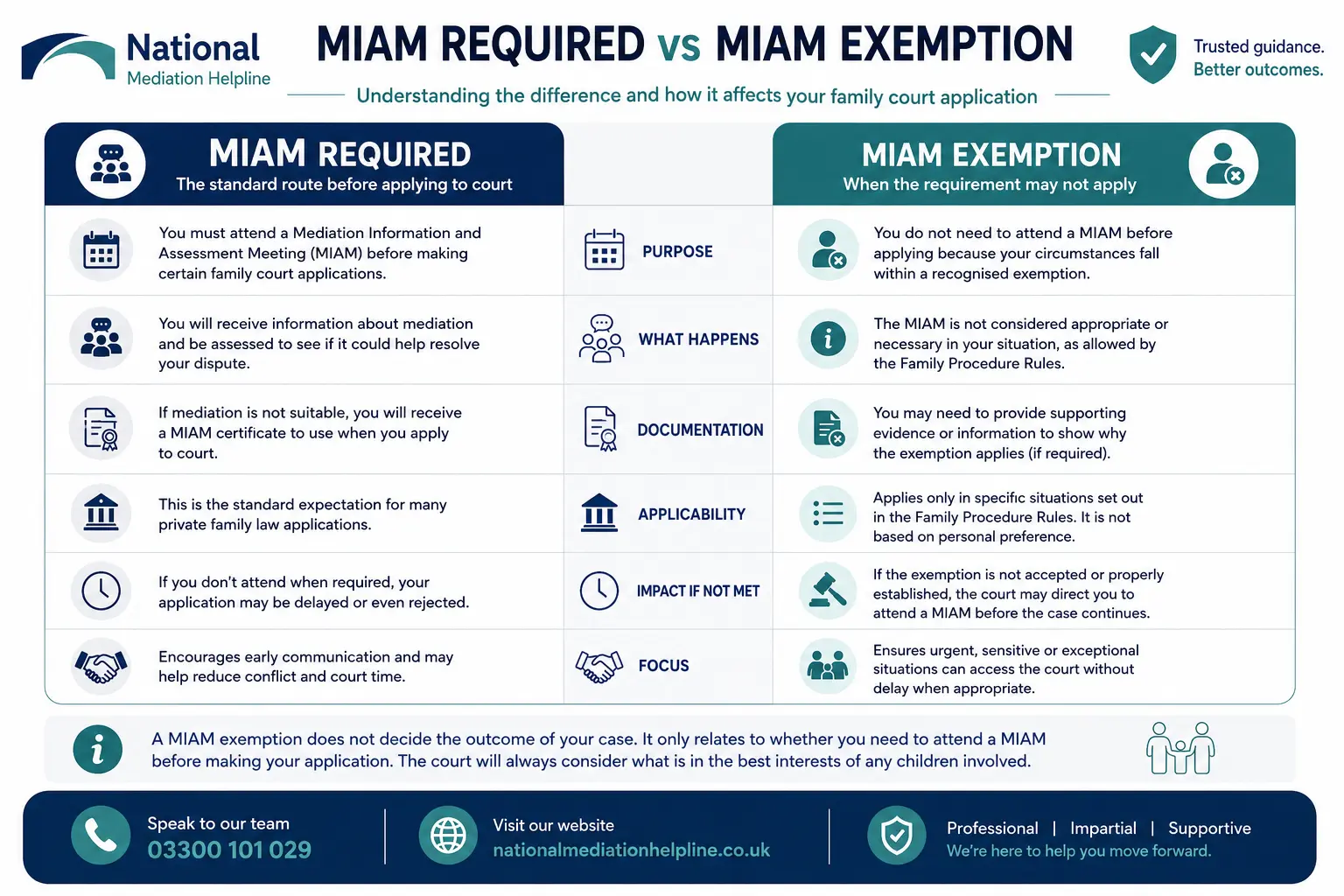
MIAM Required vs MIAM Exemption
| Situation | MIAM Usually Required | Recognised Exemption May Apply |
|---|---|---|
| Private family law application involving children | Often | Depending on the circumstances |
| Financial application following separation or divorce | Often | Depending on the circumstances |
| Certain urgent applications | Not always | May apply |
| Certain domestic abuse situations | Not always | May apply |
| Certain child protection cases | Not always | May apply |
| Existing qualifying proceedings | Not always | May apply |
Important: Whether an exemption applies depends on the facts of the individual case and the relevant procedural requirements. The court can consider whether the exemption has been correctly relied upon.
How the National Mediation Helpline in , UK, Can Help You

Understanding whether a MIAM exemption applies is often more complicated than simply reading a list of categories.
National Mediation Helpline helps individuals understand the MIAM process, explain when the pre-application requirement may apply, and provide information about recognised exemption categories before a family court application is made.
If a MIAM is required, an appointment can be arranged with an authorised family mediator.
If you believe an exemption may apply, obtaining accurate information before submitting a court application can help you understand the procedural requirements and reduce the risk of unnecessary delays.
The aim is not simply to decide whether an MIAM can be avoided.
It is to ensure you understand the correct process for your particular circumstances before proceedings begin.
How Do I Know If My Situation Qualifies for a MIAM Exemption?
Whether a MIAM exemption applies depends on the circumstances of your case and the requirements set out in the Family Procedure Rules. It is not based simply on whether you believe mediation would be unsuccessful or whether you would prefer to begin court proceedings immediately.
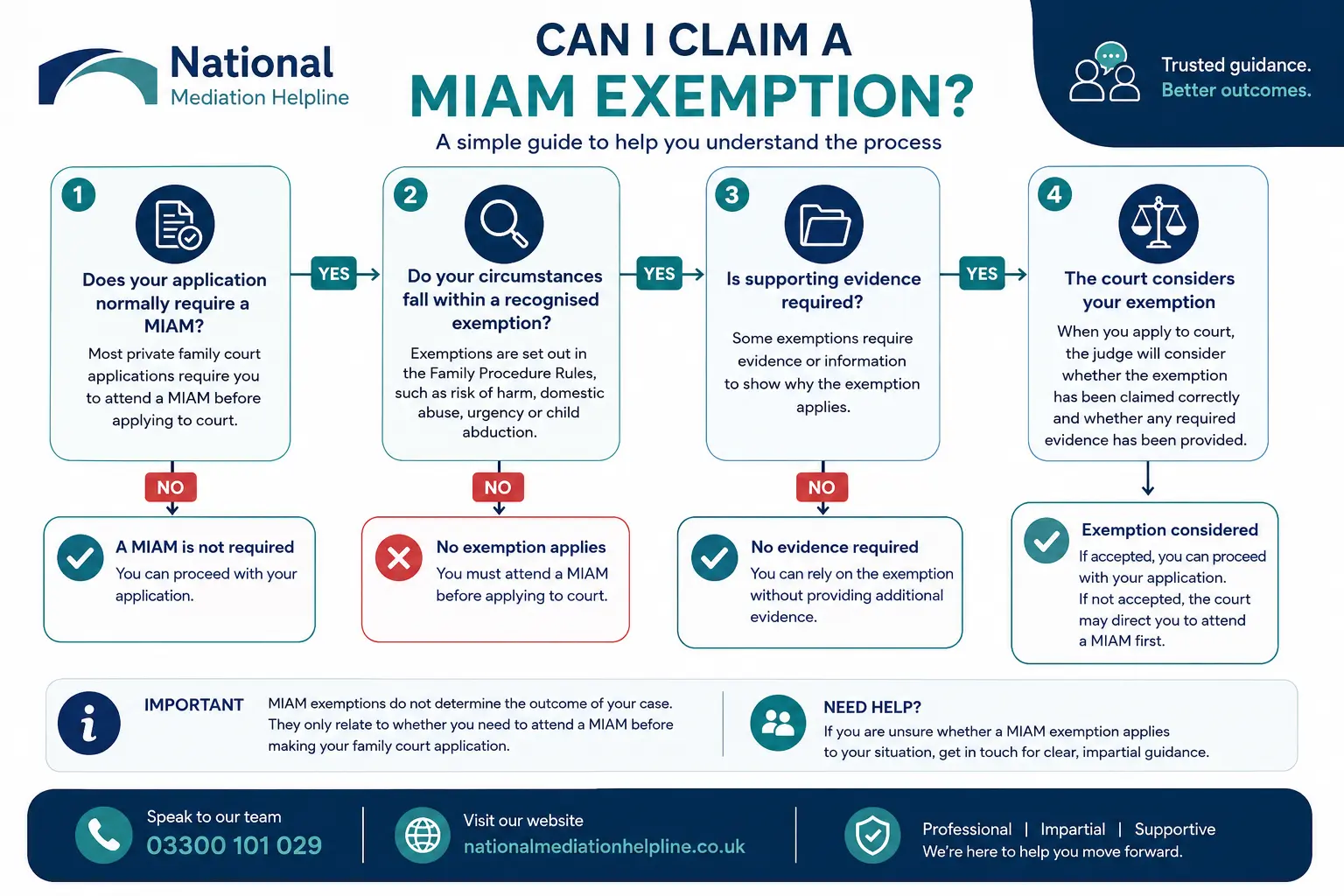
A useful way to think about the process is to ask three questions:
1. Is this the type of family court application that normally requires a MIAM?
Not every family court application falls within the MIAM requirement. The first step is to identify whether your application is one for which an MIAM would ordinarily be expected before proceedings begin.
2. Do my circumstances fall within a recognised exemption?
The Family Procedure Rules identify a number of situations where attending a MIAM before making an application may not be required. These include certain urgent cases, some situations involving domestic abuse, particular child protection matters, and other recognised procedural circumstances. Which exemption, if any, applies depends on the facts of the individual case rather than a personal preference to avoid mediation.
3. Can the exemption be relied upon correctly?
Some exemptions require supporting information or evidence when the court application is made. If an exemption is claimed incorrectly or the procedural requirements are not met, the court may find that the MIAM requirement has not been satisfied and issue further directions before the case proceeds.
The key thing to know is that an MIAM exemption forms part of the court process, not an alternative to it. Knowing whether the exemption actually applies before making an application prevents processing delays and/or the wrong procedure being followed.
What Happens If You Claim the Wrong MIAM Exemption in , UK?

Claiming an exemption that does not apply will not usually determine the outcome of your family case, but it can affect how your application progresses through the court process.
When an application is received, the court may consider whether the exemption relied upon falls within the recognised categories and whether any required supporting evidence has been provided. If the court concludes that the exemption has not been established, it may give further directions regarding the MIAM requirement before the proceedings continue.
In practical terms, this can result in avoidable delays while procedural issues are resolved.
This is one reason why relying on assumptions can create problems.
For example, many people assume that because communication with the other party has completely broken down, they automatically qualify for an exemption. Others believe that refusing mediation creates an exemption in itself.
Neither assumption is necessarily correct.
The court is concerned with whether the circumstances fall within one of the recognised exemption categories, rather than with whether mediation appears unlikely to succeed.
For applicants, the safest option is to try to establish whether a recognised exclusion actually applies before making the application, rather than relying on guesswork or directives from unofficial sources.
Doing so helps ensure that the focus remains on resolving the family dispute rather than correcting procedural issues that could have been avoided.
Frequently Asked Questions and MIAM Exemptions Explained
Do all family court applications require a MIAM?
No. The requirement depends on the type of family court application being made. In addition, the Family Procedure Rules recognise circumstances where an MIAM exemption may apply before an application is issued.
Can I claim a MIAM exemption because the other person refuses mediation?
Not automatically. One person’s unwillingness to participate in mediation does not, by itself, create a recognised MIAM exemption. Whether an exemption applies depends on the circumstances recognised within the Family Procedure Rules.
Can I choose not to attend a MIAM if I know mediation will not work?
Believing that mediation is unlikely to succeed is different from qualifying for an MIAM exemption. The court considers whether the application falls within a recognised exemption rather than whether mediation appears unlikely to result in an agreement.
Will the court ask why I claimed a MIAM exemption?
It may. If an exemption is relied upon, the court can consider whether it has been claimed correctly and whether any supporting evidence required by the procedural rules has been provided.
What happens if the court decides my exemption does not apply?
If the court concludes that the exemption requirements have not been met, it may make further directions regarding the MIAM requirement before the proceedings continue.
Does a MIAM exemption stop me from using mediation later?
No. A MIAM exemption relates to the requirement to attend the pre-application assessment meeting. If circumstances change, parties may still decide to explore mediation voluntarily.
Is every domestic abuse situation automatically exempt from a MIAM?
The Family Procedure Rules contain recognised exemptions relating to certain domestic abuse circumstances, but whether an exemption applies depends on the relevant procedural requirements and, where applicable, supporting evidence.
Can urgent family court applications qualify for a MIAM exemption?
Yes, in certain circumstances.
The Family Procedure Rules include an exemption for applications that must be made urgently. This can apply where waiting for a MIAM could put someone at risk, cause harm to a child, create a risk of unlawful removal or retention of a child, or lead to other serious consequences such as significant financial hardship or the loss of important evidence. The exemption has specific requirements, so urgency alone does not automatically remove the MIAM requirement.
Does a MIAM exemption affect the outcome of my court case?
No. An MIAM exemption concerns the procedure before certain family court applications. It does not determine how the court will decide the disputed issues.
Can both parties rely on different MIAM exemptions?
Yes. The court considers each person’s circumstances individually. One party qualifying for an exemption does not automatically mean the other party qualifies for the same exemption.
Can I still attend a MIAM even if I believe an exemption applies?
You can seek advice from an authorised family mediator about whether a MIAM is appropriate.
A MIAM exemption means that attendance is not required before making the relevant court application. It does not mean that discussing non-court dispute resolution is prohibited. The rules also allow the court to direct an applicant or the parties to attend a MIAM in some circumstances, including where an exemption was not validly claimed or is no longer applicable.
Where can I get guidance on whether a MIAM exemption may apply?
If you are unsure whether your circumstances fall within a recognised exemption category, getting guidance before submitting a family court application can help ensure you follow the correct procedure and reduce the risk of unnecessary delays.