
How to Prepare for a MIAM in , UK
Quick Answer
- Preparing for a MIAM is less about collecting paperwork and more about understanding the issues you want to resolve.
- Before attending, think about the matters you want to discuss. Any concerns about safety or communication, and what you hope to achieve from the meeting.
- A MIAM is an assessment meeting, not a negotiation. You are not expected to reach agreements during the appointment.
- Honest preparation often leads to a more productive discussion because the mediator can better understand your circumstances and whether mediation is appropriate. Official guidance also makes clear that the mediator’s role includes explaining dispute resolution options and assessing suitability for mediation.
Separation and family disputes rarely leave people feeling organised. By the time a MIAM has been arranged, many people are dealing with uncertainty, practical pressures and difficult conversations.
Preparing properly will not change the issues that brought you there. But it can make the meeting more useful. Instead of spending the appointment trying to organise your thoughts, you can focus on explaining your circumstances clearly and understanding what options may be available. We are going to explore all of that in this guide on how to prepare for a MIAM.
Why Is It Worth Preparing Before a MIAM?
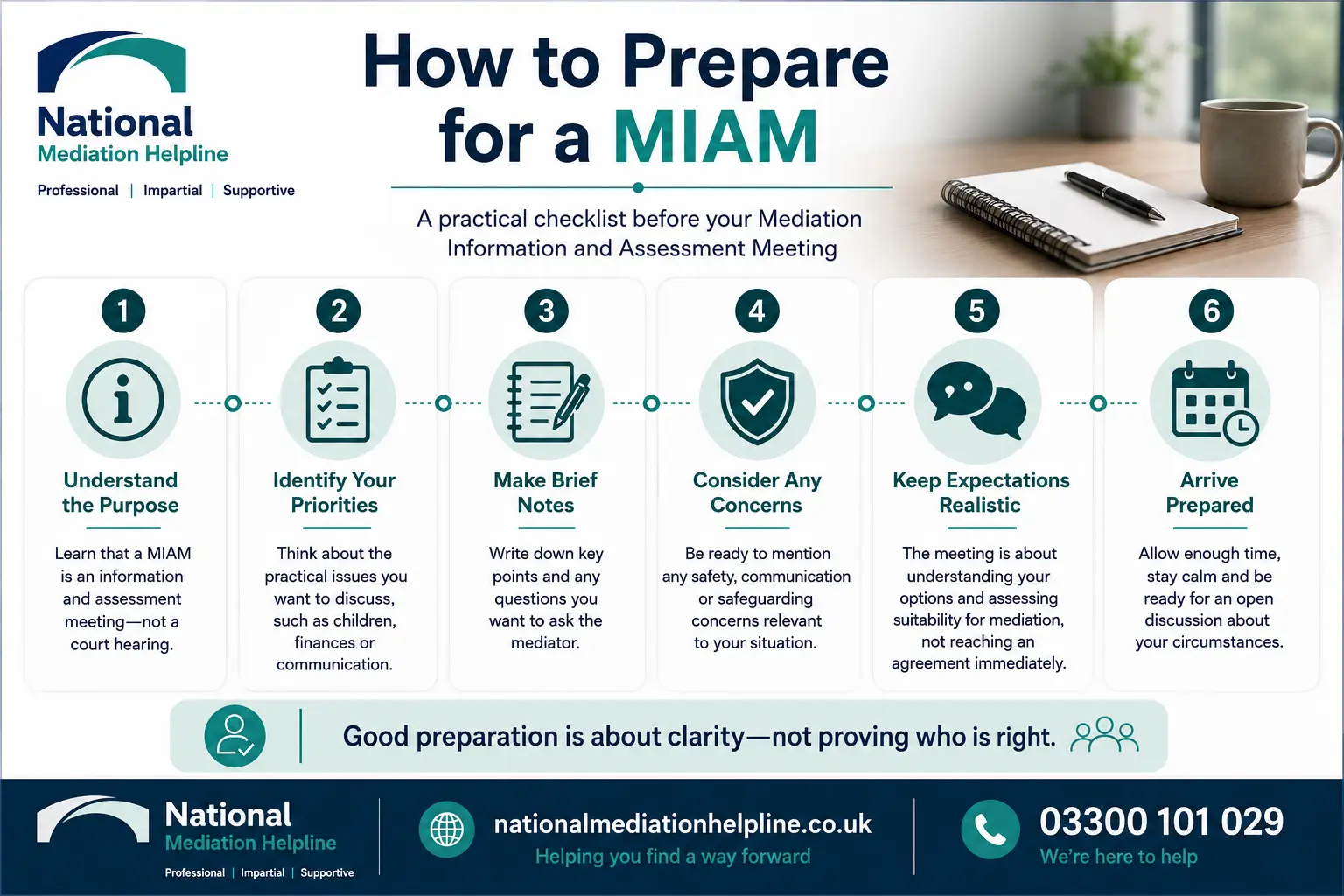
A little preparation helps the mediator understand your situation more accurately and allows the conversation to focus on the issues that matter most.
A MIAM is designed to provide information about mediation and other appropriate forms of non-court dispute resolution while allowing the mediator to assess whether mediation appears suitable in the circumstances. Arriving with a clear understanding of your concerns makes that assessment easier and often leads to a more focused discussion.
Preparation also benefits you.
Many people attend expecting to defend themselves or convince the mediator that they are right.
That is not the purpose of the meeting.
The mediator is there to understand the dispute, identify any safeguarding concerns, explain the available options and consider whether mediation is appropriate. Knowing that beforehand often reduces unnecessary anxiety.
Read More | All About Family Mediation, Processes and Expected Outcomes.
What Should You Think About Before Your Appointment?
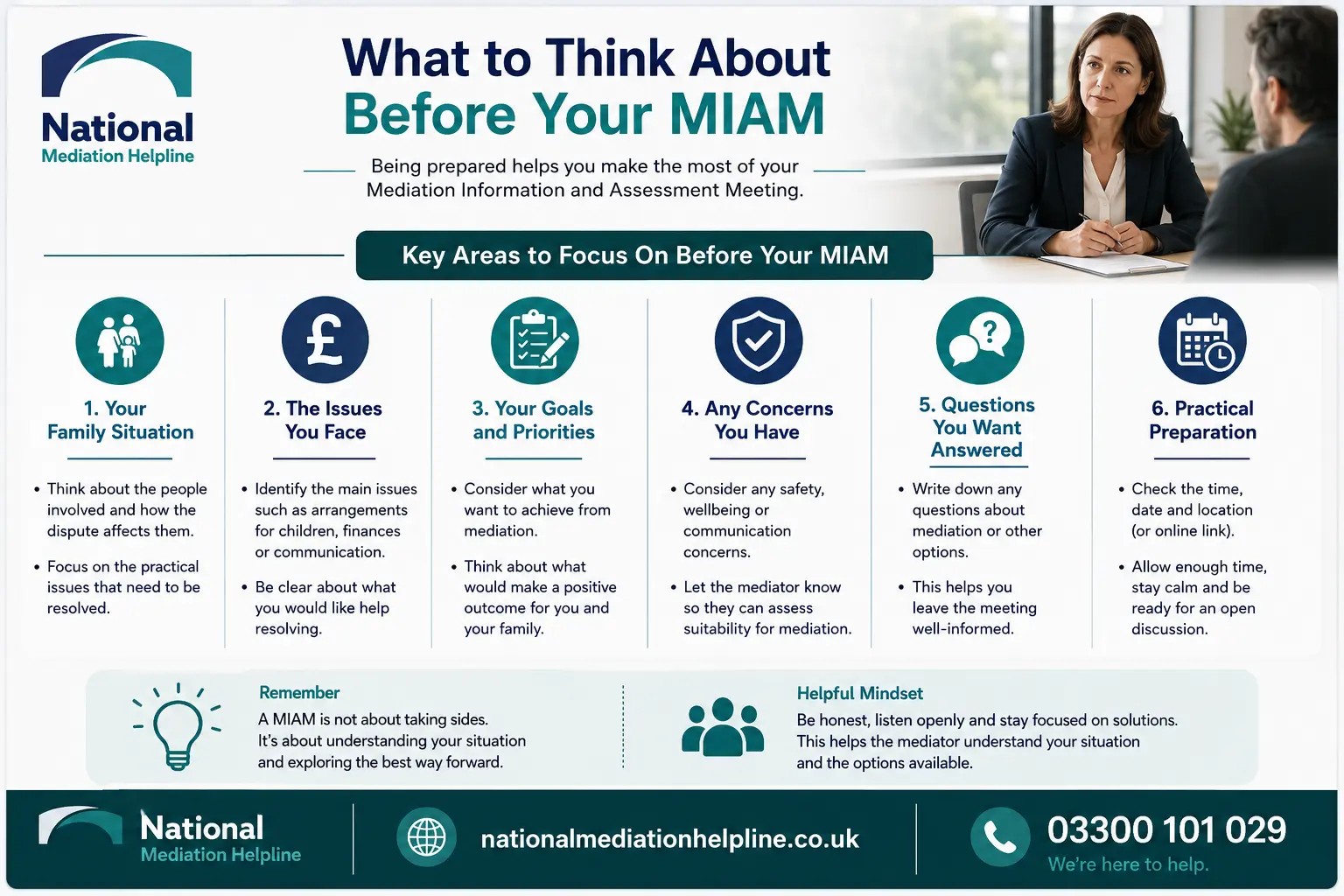
One of the best ways to prepare is to spend a few minutes identifying the issues that have led to the dispute.
Rather than mentally replaying every disagreement, focus on the practical matters that still need to be resolved.
Depending on your circumstances, those issues might include:
- Arrangements relating to children post-separation.
- Financial matters following separation.
- Communication difficulties.
- Concerns about future decision-making.
- Immediate issues that need attention.
You do not need to prepare a speech or persuade the mediator that your position is correct.
Clear, honest explanations are usually far more useful than trying to present every detail of the history between you and the other person.
Check Here: Why It is Essential to Go to MIAM First, Before Going to Court.
How Can You Prepare Emotionally for a MIAM?

It is completely normal to feel anxious before an MIAM.
For many people, this is the first structured conversation they have had about the dispute since the relationship changed. Others worry that they will be judged or pressured into making decisions before they are ready.
Neither should happen.
A MIAM is an opportunity to discuss the circumstances, understand how mediation works and consider whether it is an appropriate way to move forward. Attending does not commit you to mediation, nor does it require you to reach an agreement during the meeting.
It often helps to approach the appointment with realistic expectations.
The goal is not to solve every issue immediately.
The goal is to understand the next appropriate step.
What Preparation Mistakes Do People Commonly Make?
Most preparation mistakes have nothing to do with paperwork.
Instead, they happen because people misunderstand the purpose of the meeting.
Common examples include:
| Mistake | A Better Approach |
|---|---|
| Treating the MIAM like a court hearing | Treat it as an information-and-assessment meeting. |
| Trying to prove who is right | Focus on explaining the circumstances clearly. |
| Assuming mediation has already been decided | Remember that the mediator first considers whether mediation is suitable. |
| Arriving without thinking about the issues to discuss | Spend time identifying the practical matters you want to raise. |
| Expecting agreements to be reached immediately | Understand that the meeting is primarily about assessment and information. |
Many people leave a MIAM saying they felt more comfortable once they realised they were not expected to argue their case.
Understanding the purpose of the meeting beforehand often removes much of the uncertainty.
How Should You Organise Your Thoughts Before a MIAM?

You do not need to arrive with every detail worked out.
What usually helps most is having a clear picture of the issues that still need to be resolved and explaining them calmly. Mediators are interested in understanding the situation, not hearing every disagreement that has taken place over months or years. The Family Mediation Council’s guidance also encourages mediators to manage expectations and explain the process clearly at the outset of the meeting.
Before your appointment, consider writing down:
- The main issues you would like to discuss.
- Any immediate concerns affecting you or your family.
- Questions you would like answered about mediation.
- Any practical matters that cannot wait.
- Anything you feel the mediator should understand before deciding whether mediation is suitable.
Keeping your notes short can actually make them more useful. A page of clear bullet points is often easier to work from than trying to remember every conversation or disagreement.
Read More | Read and Check if You are Eligible for the Family Mediation Voucher Scheme in , UK
Should You Prepare Evidence or Build Your Case ?
Generally, no.
A common mistake is treating an MIAM like the first stage of a court hearing. People sometimes arrive with lengthy timelines, folders of correspondence or messages, expecting the mediator to decide who is right.
That is not the purpose of the meeting.
The mediator is assessing whether mediation is appropriate and explaining the available options. The discussion is intended to help everyone understand the process rather than determine the merits of the dispute.
Being open, factual and organised is usually more valuable than trying to prove a point.
If particular documents become relevant later in the mediation process, the mediator can explain what information may assist those discussions. Preparing for the MIAM itself is primarily about understanding your circumstances, not assembling evidence.
Check Here : What is a consent order in , UK
💡 What Most People Wish They Had Done Before Their MIAM

Many people look back on their MIAM and realise they spent too much time thinking about what the other person might say.
A more productive approach is to focus on your own objectives.
Ask yourself:
- What decisions are critical and need to be made?
- Which issues are the most important ones?
- What outcome would improve the situation for everyone involved?
- Are there concerns that the mediator needs to know about before mediation is considered?
Approaching the meeting with those questions in mind often leads to a more focused conversation than rehearsing every disagreement that has occurred since the relationship broke down.
How Can You Make the Most of Your MIAM?
Preparation does not stop when you walk through the door. This is where the guide How to prepare for a MIAM helps.
Listening carefully, answering questions honestly and asking for clarification whenever something is unclear can make the meeting far more valuable than simply attending because it is required.
Remember that a MIAM is an opportunity to understand the process and to explain your circumstances.
If something is unfamiliar, whether it relates to mediation itself, other forms of non-court dispute resolution or what may happen next. It is perfectly reasonable to ask.
The purpose of the meeting is to help you make an informed decision about the most appropriate way to move forward, not to pressure you into a particular outcome. The Family Mediation Council’s standards emphasise providing participants with clear information about mediation, voluntariness and the available options before any decision is made.
How the National Mediation Helpline, , UK Can Help You

Preparing for a MIAM should leave you feeling informed rather than overwhelmed.
National Mediation Helpline, {nam} provides access to authorised family mediators who can explain how the MIAM process works, answer questions about the appointment and help you understand what to expect before you attend. We Will even help you for how to prepare for a miam.
Whether your concerns relate to children, finances or another family matter, understanding the process in advance can make the meeting more constructive and reduce unnecessary uncertainty.
Good preparation is not about having every answer before the appointment.
It is about arriving with a clear understanding of your circumstances, realistic expectations and the confidence to discuss the issues that matter most.
Practical MIAM Preparation Checklist: How To Prepare For a MIAM
Preparing well for a MIAM is not about producing the biggest file of paperwork. It is about arriving ready to have a constructive conversation and understanding what you want from the meeting.
Use this checklist before your appointment.
| Before Your MIAM | Why It Helps |
|---|---|
| Understand the purpose of a MIAM | It helps you approach the meeting with realistic expectations rather than treating it like a court hearing. |
| Identify the main issues you want to discuss | Keeps the conversation focused on the matters that genuinely need attention. |
| Think about your preferred outcomes | Gives the mediator a clearer understanding of what you hope to achieve. |
| Make a note of any safeguarding or communication concerns | These may be relevant when assessing whether mediation is suitable. |
| Write down any questions about the mediation process | Ensures you leave the meeting with a better understanding of your options. |
| Allow enough time to attend without rushing | Being calm and prepared often leads to a more productive discussion. |
This is not a checklist for proving your case. It is simply a way to ensure you arrive ready to have a meaningful conversation about what happens next. This is the best way we could answer your question how to prepare for a miam.
What Should You Avoid Before a MIAM?
How you prepare can influence how comfortable and productive the meeting feels. A few common habits tend to make the experience harder than it needs to be.
Avoid trying to memorise every disagreement or rehearse every argument.
Instead, concentrate on the issues that still require decisions.
It is also worth avoiding assumptions about how the meeting will end.
Some people arrive convinced that mediation will definitely happen.
Others assume it will definitely fail.
Neither outcome is decided before the assessment takes place. One purpose of the MIAM is for the mediator to explore whether mediation appears suitable after understanding the circumstances of everyone involved.
Finally, do not hesitate to ask questions.
If there is something you do not understand about the process, raising it during the meeting is usually more helpful than making assumptions beforehand.
You also have an option to explore, which is Shuttle Mediation in , UK
The Best Steps Forward and National Mediation Helpline
Preparing for a MIAM is not about saying the right things.
It is about giving yourself the best opportunity to have an informed conversation.
The more clearly you understand your own circumstances, priorities and concerns, the easier it becomes for the mediator to explain your options and assess whether mediation is appropriate.
Good preparation will not remove the challenges that often accompany family disputes.
What it can do is help you walk into the meeting feeling organised, realistic and ready to discuss the issues that matter most.
Frequently Asked Questions: How To Prepare For a MIAM
Do I need to prepare notes before a MIAM?
This might be the first confusing question in your mind after how to prepare for a miam. But, You do not have to, but many people find it useful. A short list of the issues they want to discuss, along with any questions they have about mediation, can help keep the meeting focused.
Should I prepare a timeline of everything that has happened?
Usually not. A MIAM is not intended to determine who was right or wrong. A concise explanation of the current situation is generally more useful than a detailed history of every disagreement.
Is it a good idea to write down my questions before the appointment?
Yes. If there is anything you are unsure about—such as how mediation works or what happens afterwards—having your questions written down can help ensure they are answered during the meeting.
Should I speak to the other person before attending my MIAM?
That depends on your circumstances. Some people are comfortable discussing practical arrangements beforehand, while others are not. A MIAM does not require you to negotiate with the other person before your appointment.
What if I feel nervous before my MIAM?
That is very common. Many people attending a MIAM have never been involved in mediation before. Understanding the purpose of the meeting and preparing a few notes often helps reduce uncertainty.
Do I need to know exactly what outcome I want?
No. It can help to think about your priorities, but you are not expected to arrive with all the answers. The MIAM is designed to help you understand your options before making any decision about mediation.
Should I prepare differently if the dispute involves children?
The practical preparation is much the same. It helps to think carefully about the issues you believe need to be resolved and any concerns that you feel the mediator should understand when assessing whether mediation is appropriate.
Can I change my mind after attending a MIAM?
Yes. Attending a MIAM gives you information about mediation and other options for resolving disputes. Whether mediation goes ahead depends on the circumstances and the decisions made after the assessment meeting.