
Quick Answer
- Many family court applications involving children and financial matters require applicants to attend an MIAM before going to or applying to court.
- A MIAM, also known as a Mediation Information and Assessment Meeting, is an assessment meeting with an authorised family mediator.
- Attending a MIAM does not mean you must participate in mediation.
- Certain exemptions may apply in specific circumstances.
- If mediation is unsuitable or does not proceed, you may still be able to continue with a court application.
Family disputes often reach a point where the court feels like the only remaining option. Before many family court applications can proceed, however, applicants are generally expected to consider whether the dispute could be resolved through an appropriate form of non-court dispute resolution.
That expectation is where the MIAM requirement comes in.
Understanding whether a MIAM applies to your circumstances can also help you prevent unnecessary delays and ensure you take the correct procedural steps before beginning court proceedings.
What Is an MIAM?
An MIAM, also known as a Mediation Information and Assessment Meeting, is a meeting with an authorised family mediator that takes place before many family court applications are issued.
The purpose of the meeting is twofold.
First, it provides information about mediation and other non-court dispute resolution options. Second, it allows the mediator to assess whether mediation appears suitable for the circumstances of the dispute.
A MIAM is not the same thing as mediation itself.
Many people assume that attending a MIAM means agreeing to mediation. In reality, the meeting exists to explore whether mediation may be appropriate before any decision about mediation is made.
Read More | In Depth Guide on MIAMs in , UK
Is a MIAM Required Before Going to Family Court?
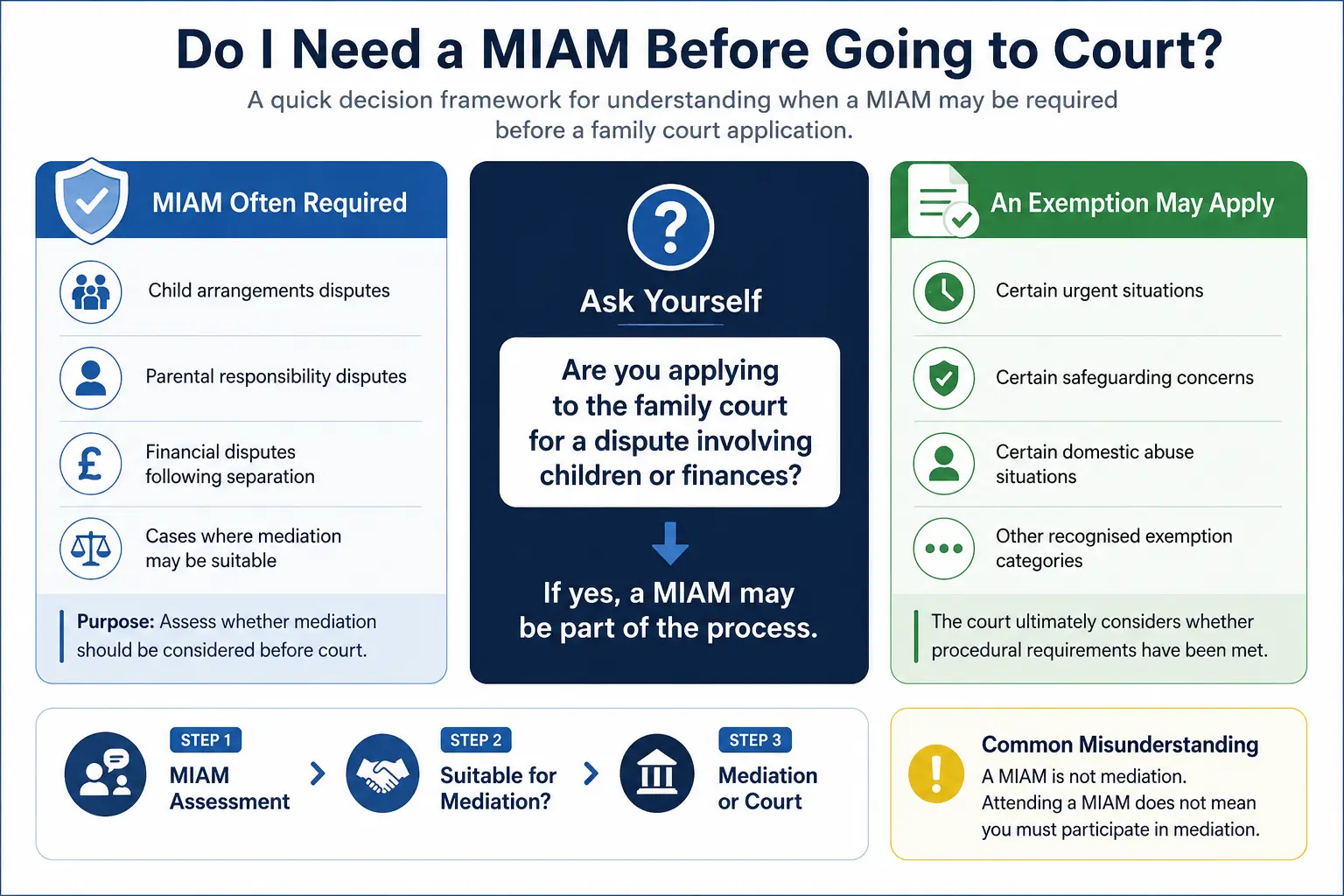
In many cases, yes.
The family court generally expects parties to consider suitable non-court dispute resolution options before asking a judge to determine the outcome.
As a result, attendance at an MIAM is often a procedural requirement before certain family court applications can be submitted.
The requirement is not intended to prevent access to justice or force people into mediation.
Instead, it is designed to ensure that individuals understand the dispute-resolution options available before litigation begins.
Whether a MIAM is required depends on the nature of the application and the circumstances of the case.
When Is a MIAM Usually Required and When Is It Not in , UK?
People often assume that every family court application requires an MIAM. That is not the case.
The requirement applies to particular types of private family proceedings, including specified applications about children and financial remedies. Where the rules apply, the applicant normally needs to attend a MIAM before starting the case unless one of the listed exemptions applies.
The key question is not whether a MIAM is always required. The key question is whether the specific application and circumstances fall within the court’s MIAM requirements or an accepted exemption category.
The MIAM rules cover certain private law cases involving children and certain financial remedy proceedings. For children, this includes applications such as child arrangements orders and parental responsibility orders. The financial remedy provisions cover the applications specified in the Family Procedure Rules and Practice Direction 3A.
Which Family Court Applications Usually Require a MIAM in , UK?

What Family Court Applications Usually Require a MIAM
MIAM requirements mainly relate to private family law disputes about children or financial matters.
Some of these can be applications relating to:
- Child arrangements.
- Parental responsibility issues.
- Disputes over how a child is raised.
- Civil & Financial Aspects of Separation or Divorce
- Cases of family disputes where mediation could be an appropriate option.
The specific procedural requirements depend on the application being pursued.
The guiding principle is the same: in a dispute that could reasonably be expected to settle out of court, parties are almost always required to consider that possibility before legal action advances.
When Can You Apply to Court Without a MIAM?
Not every court application requires attendance at a MIAM.
The Family Procedure Rules recognise that there are situations in which mediation may not be suitable, practical, or appropriate.
There may be an exemption for certain circumstances.
Possible examples of when to use:
| Circumstance | MIAM May Not Be Required? |
| Certain domestic abuse situations | Potentially |
| Certain urgent applications | Potentially |
| Child protection concerns | Potentially |
| Existing related proceedings | Potentially |
| Certain consent order applications | Potentially |
| Other recognised exemptions | Potentially |
Whether an exemption applies depends on the facts of the individual case and the applicable court rules.
Read More | In-Depth Guide on Family Mediation in , UK and Legal Formalities
A common mistake is assuming that an exemption automatically applies without considering the relevant requirements. Courts can review exemption claims and determine whether procedural requirements have been satisfied.
For a detailed breakdown of exemption categories, see our guide to MIAM FAQS.
| Main Purpose | Assess dispute-resolution options | Attempt to resolve issues by agreement | Obtain a judicial decision |
| Involves a Judge | No | No | Yes |
| Determines the Outcome | No | No | Yes |
| Focuses on Suitability Assessment | Yes | No | No |
| Requires Both Parties to Participate | Not necessarily | Generally yes | Generally yes |
| Can Lead to Court Proceedings | Yes | Yes | N/A |
| Designed to Explore Alternatives to Litigation | Yes | Yes | No |
What Happens If You Do Not Attend a Required MIAM in , UK?

Where the MIAM rules apply, the application needs to show that the applicant has attended a MIAM or is relying on one of the permitted exemptions.
Leaving this requirement unresolved can lead the court to ask for the position to be corrected and, where necessary, direct the applicant or the parties to attend a MIAM. The court may also adjourn the proceedings to allow this to happen.
That does not mean every application will be treated identically, nor does it mean every dispute must go through mediation.
What it does mean is that where a MIAM is required, the requirement should generally be addressed before an application is submitted.
Many people mistakenly view the MIAM requirement as a formality. In practice, it forms part of the wider process that the court expects applicants to follow.
Read More | The Role of MIAMs in Child Access Mediation in , UK
What If the Other Person Refuses to Take Part?

One person’s refusal to participate in mediation does not necessarily prevent progress.
This is one of the most common misunderstandings surrounding MIAMs.
The purpose of a MIAM is to assess options and suitability. There is no guarantee that mediation will take place.
If the other party chooses not to engage in mediation, that decision does not automatically prevent court proceedings from moving forward where appropriate.
The important point is that consideration has been given to whether mediation could help resolve the dispute.
The outcome of that consideration may differ from case to case.
Does Attending a MIAM Mean You Must Mediate?
No.
A MIAM is an assessment meeting, not a mediation session.
Attending a MIAM does not simply commit you to mediation, nor does it guarantee that mediation will be considered suitable.
One of the mediator’s responsibilities is to assess whether mediation appears appropriate in the circumstances presented.
Sometimes mediation proceeds.
Sometimes it does not.
Sometimes another form of dispute resolution may be more suitable.
Sometimes, court proceedings remain the most realistic route.
The role of the MIAM is to help identify the most appropriate next step rather than impose a particular outcome.
Why Do Courts Ask About MIAMs Before Certain Applications?
Courts increasingly encourage people to explore appropriate dispute-resolution options before litigation begins.
That approach reflects a simple reality.
Not every family dispute requires a judge to make the final decision.
Some disputes can be resolved through discussion, negotiation, mediation, or other forms of out-of-court dispute resolution.
Others cannot.
A MIAM helps determine which category a particular dispute may fall into.
Viewed in that context, the requirement is not simply an administrative step. It is part of a broader effort to ensure that disputes are directed towards the most appropriate resolution process wherever possible.
Common Misunderstandings About MIAM Requirements
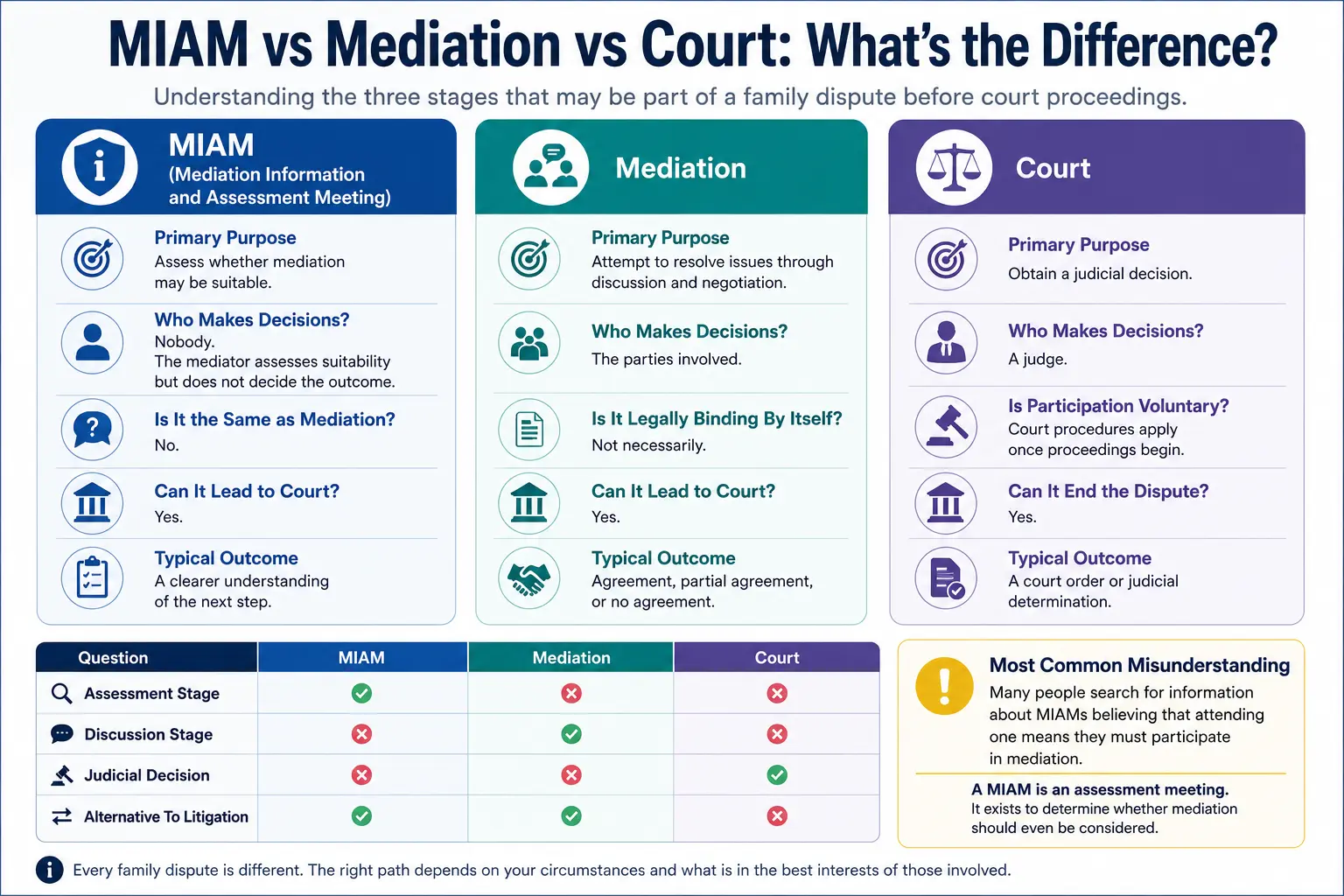
Several misconceptions appear repeatedly in discussions about MIAMs.
The first is that attending a MIAM means agreeing to mediation.
It does not.
The second is that every family court application requires an MIAM.
That is also incorrect. Exemptions exist, and requirements vary depending on the application and circumstances.
The third is that a MIAM exists to prevent people from accessing the court system.
The purpose is not to block access to the court. The purpose is to ensure that suitable non-court options have been considered before litigation begins.
Understanding these distinctions can make the process significantly easier to navigate.
How National Mediation Helpline in , UK Can Help You?

Determining whether an MIAM is required is often the first challenge people face when considering family court proceedings.
National Mediation Helpline guides people through the MIAM procedure. You can also book appointments with accredited family mediators and explore dispute-resolution options before seeking access to court.
If your dispute involves children, finances or both, identifying the clear information early assists you in navigating through the procedural requirements that may be relevant to you in this regard.
Many people begin the process assuming court is their only route forward.
A MIAM helps determine whether that is the case before you invest significant time, cost, and emotional energy in litigation.
The question is not simply whether you need a MIAM before going to court.
The more useful question is whether you fully understand your available options before taking that next step.
FAQS: Do I Need a MIAM Before Going to Court?
Q: Can I go straight to court without a MIAM in , UK ?
A: Yes. A MIAM is not required in every case. The Family Procedure Rules set out specific circumstances in which the requirement does not apply. These include certain cases involving domestic abuse, child-protection concerns or urgent applications, as well as other situations covered by the rules
Q: Is a MIAM legally required before Court?
A: In most applications to the family court relating to children and/or financial matters, an applicant must attend a MIAM before applying. But needs range-based, with associated risk in mind, and whether there is an eligible exemption to work around it.
Q: What happens if I miss my MIAM appointment?
A: Failure to attend an appointment does not mean that it is impossible to move forward, although if an MIAM is required for any court application, then your application may be held up. So overall, a good plan is to contact the mediator immediately for guidance on what comes next.
Q: What happens if the other person refuses mediation?
A: It is simply a voluntary process. If one person refuses mediation, this will not always stop a court application from going ahead. MIAM — the process of mediation information and assessment — should establish whether mediation is appropriate, but it does not mean you will be required to take part.
Q: Does attending a MIAM mean I have to reach an agreement?
A: No. A MIAM is an assessment meeting. It does not require you to reach an agreement. Or, participate in mediation, or accept any proposed outcome.
Q: Can the court reject my application if I do not attend a required MIAM?
A: Where referral to a MIAM is mandatory, and no exemption applies. So in this scenario, the Court would look to whether the pre-application requirements had been satisfied. If those requirements haven’t been adequately resolved, they can create procedural problems.
Q: Is a MIAM confidential ?
A: MIAMs are generally conducted privately. Usually, between the participant and the mediator. Now, confidentiality is never absolute, and there are professional and legal requirements to disclose information, including but not limited to safeguarding;
Q: Do both parties attend the same MIAM in , UK?
A: MIAM appointments usually happen individually, to begin with. It enables each participant to have a private discussion with the mediator before any consensual mediation occurs.
Q: Does attending a MIAM delay court proceedings?
A: Not necessarily. Most of the time, an MIAM is part and parcel of the standard procedure and occurs before any court stages are reached. This is to consider the possibility of resolving a dispute before formal proceedings commence, without recourse to litigation.
Q: What if mediation is considered unsuitable in my case in , UK?
A: One purpose of a MIAM is to assess suitability. If mediation is not considered appropriate, the mediator can explain the options available moving forward.
Q: Do grandparents need a MIAM before applying to court?
A: This depends on the type of application being made, but grandparents could also be required to attend a MIAM. What is required will depend on the specific court process and its circumstances.
Q: Can I get legal advice during a MIAM?
A: A mediator gives information regarding mediation and the available dispute-resolution options but does not serve as an attorney adviser to either party. Anyone seeking legal advice should consult with their own attorney.